
WORKS
BACK TO ALL WORKS


Delphi chair
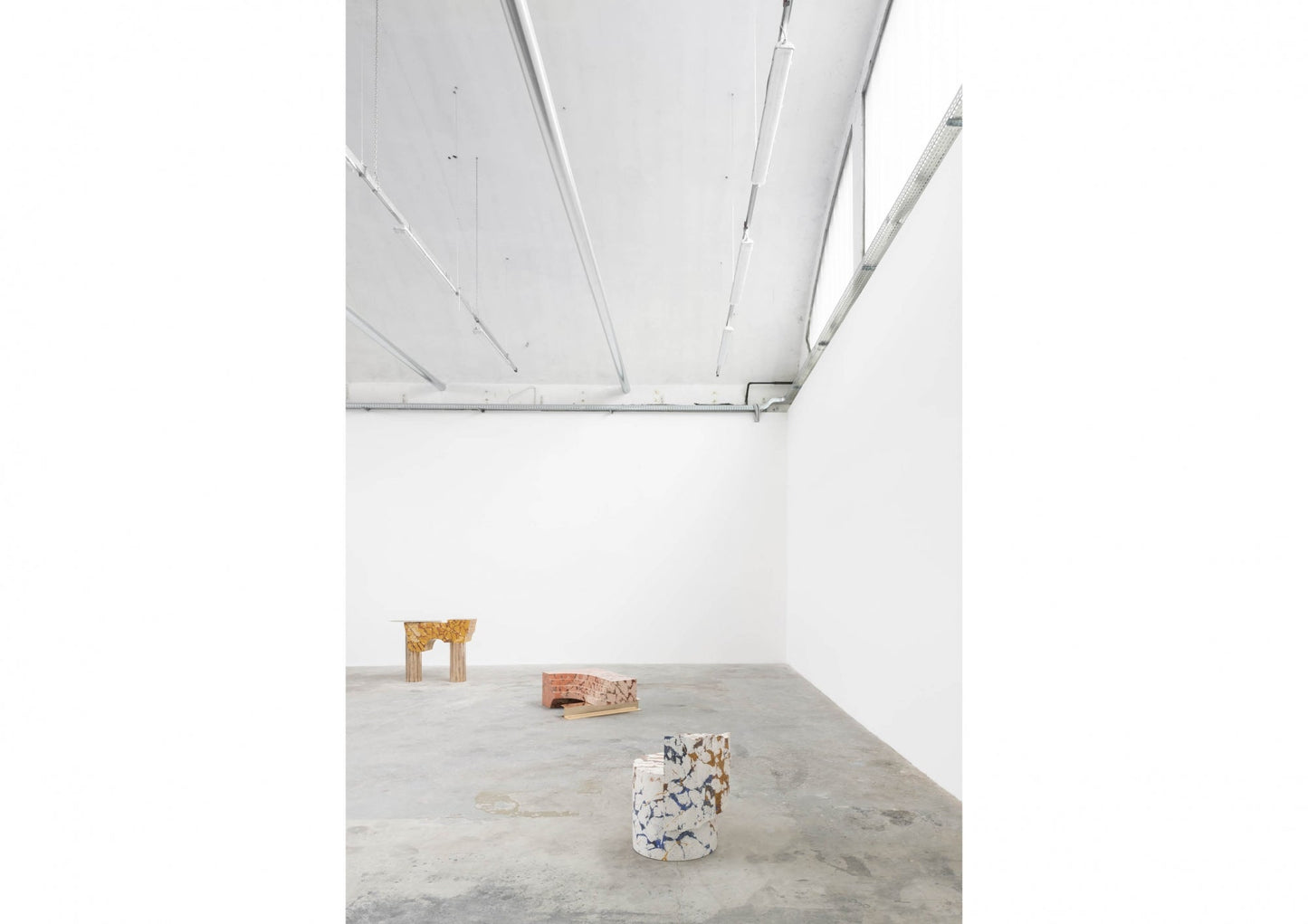
Ruins by Roberto Sironi is a series of works that re-signify architectural fragments belonging to different historical periods and great archaeological sites, modelling the forms according to new aesthetic representations. The project relates constructive elements of the classical era, such as bases of columns, capitals, sections of an amphitheatre, with rudiments of the industrial era, such as the double-T beams and the reticular structural elements. Roberto Sironi elaborates on the concept of ruins according to a new perspective. Conceived as contemporary ruins, imaginary simulacra and/or programmed artifices – the materials and techniques of execution do not correspond to the original. The work shows how different fragments of architectural remains can be overlaid and re-signified, resetting the temporal distances and suspending the notion time.
The Delphi chair refers to the complex of ruins of Delphi in Greece, and in particular to the circular-plan temple of Athena, the spiritual center of the ancient world and therefore omphalos or navel of the world. The piece is made in Marmo di Rima through the reproduction of a white breccia with ocher and blue veins, conceived as a marble block on which a fragment of a fluted column is grafted, a significant elements of the archaeological site of Delphi.
Limited Ed. 6+2AP in Marmo di Rima



THE DESIGNER

Roberto Sironi
Desio, Italy
Roberto Sironi (1983) is an Italian designer, who lives and works in Milan. His design practice is defined by a research-based and process-oriented approach, where thinking and making converge in the creation of artifacts, which are considered narrative tools to trigger a dialogue with the user. This approach materializes through a body of work that breaks with the primary function by blurring the boundary between functional object and sculpture; the artifacts produced are the result of a process in which the subjects addressed are investigated through an in-depth analysis from a historical, geographical and anthropological point of view.
The works are conceived as contemporary ultra-signs, where the transformation processes re-signify the matter, revealing its unseen qualities and giving it new features.The practice, founded in 2015, embraces different types of design practices, such as product and installation design, strategic research and design consultancy, through the collaboration with institutions, galleries and companies. Roberto Sironi also combines his practice with teaching and research activity in the Design Department of Politecnico di Milano, where his studies focus on new technologies for design.

Domus Pompeii Fauno Domus Pompeii Fauno

Hubert Mirror Hubert Mirror

Turin dining table Turin dining table

Olympia coffee table Olympia coffee table

Domus Pompeii Vettii Domus Pompeii Vettii

Palmyra bench Palmyra bench

APHANÈS CONSOLE APHANÈS CONSOLE

FUOCO Side Table FUOCO Side Table

Domus Pompeii Dioscuri Domus Pompeii Dioscuri

Knossos console Knossos console

Domus Pompeii Efebo Domus Pompeii Efebo

Domus Pompeii Menandro Domus Pompeii Menandro
Domus Pompeii Fauno Domus Pompeii Fauno
Hubert Mirror Hubert Mirror
Turin dining table Turin dining table
Olympia coffee table Olympia coffee table
-
Domus Pompeii Menandro Domus Pompeii Menandro
By Roberto Sironi -
FUOCO Candle Holder FUOCO Candle Holder
By Roberto Sironi -
APHANÈS SIDE TABLE APHANÈS SIDE TABLE
By Roberto Sironi -
APHANÈS DESK APHANÈS DESK
By Roberto Sironi -
APHANÈS BENCH APHANÈS BENCH
By Roberto Sironi -
FUOCO Table Mirror FUOCO Table Mirror
By Roberto Sironi -
APHANÈS ROUNDED LOW TABLE APHANÈS ROUNDED LOW TABLE
By Roberto Sironi -
Baalbeck coffee table Baalbeck coffee table
By Roberto Sironi -
Eiffel Low Table Eiffel Low Table
By Roberto Sironi -
Volubilis side table Volubilis side table
By Roberto Sironi


-
Domus Pompeii Menandro Domus Pompeii Menandro
By Roberto Sironi -
FUOCO Candle Holder FUOCO Candle Holder
By Roberto Sironi -
APHANÈS SIDE TABLE APHANÈS SIDE TABLE
By Roberto Sironi -
APHANÈS DESK APHANÈS DESK
By Roberto Sironi